
This is a Guest Blog Written by Victoria Williamson
 Victoria Williamson is an award-winning author and former teacher who writes and edits Key Stage 2 books (ages 7-11) for an education publisher. She spends the rest of her time writing books for other publishers, and visiting schools, libraries and literary festivals to give author talks and run creative writing workshops. Her latest book, published in March 2026, is ‘Children of the Ocean: A Skara Brae Mystery’.
You can find Victoria on her website: www.strangelymagical.com
This blog was edited by Gemma Molyneux. Find out more about Gemma on this page
Photo by Aron Visuals on Unsplash
Teachers and parents have long understood the power of books to stimulate children’s imaginations, making them not just better readers and writers, but better at empathising with other people too. But how often do we stop to ask ourselves, ‘Whose stories are we telling?’
As a former primary school teacher who now writes children’s books, I’ve learnt about the importance of diverse representation in fiction. I’ve seen first-hand how children’s eyes light up when they see main characters like themselves in books – characters from minority ethnic backgrounds, characters with disabilities, and characters facing social issues such as family financial difficulties and homelessness. However, it’s only been more recently – through studying history with Dundee University and the Open University, and archaeology with Aberdeen University – that I’ve started thinking more deeply about the historical stories we teach children about in the classroom.
Ask children what they’ve learnt about the Romans, and they’ll likely tell you about soldiers and gladiators. Ask them about medieval times, and you’ll probably get answers back about knights and castles. But most ordinary people in the British Isles during the Roman occupation were neither soldiers nor gladiators, and few in medieval times were rich enough to own war horses, or lived close enough to a population centre to have ever seen a castle. Even the Industrial Revolution conjures up images of steam trains, innovative factory machinery and impressive feats of architecture and engineering, with the experiences of the ordinary men, women and children who laboured in the coal mines and textile mills often being overlooked.
With primary education only becoming universal in Britain in the late 1800s and many people before this time being illiterate, it’s not surprising that it’s mostly the voices of the wealthier, literate classes that have been recorded for posterity. Recently, historians have been placing a greater emphasis on ‘reading between the gaps’ and reconstructing the lives of ordinary people through reinterpreting historical records. However, for children in the classroom, who might struggle with such a complex analysis, one of the best ways to help them understand the daily lives of everyday people in the past is through handling real-life objects.
As a child, I was lucky enough to have a wonderful local museum with displays of reconstruction Roman armour and exhibits explaining the history of the local iron industry. However, what I found most engaging was the hands-on experience the museum gave children of traditional household chores such as carding, spinning and weaving. It was through handling these objects that I was able to imagine what life must have been like for people living in the days before electricity was discovered and all the mod cons of our present age were invented.
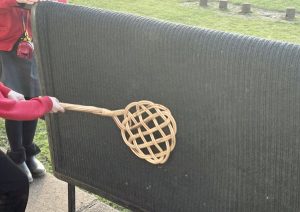
These early experiences of living history sparked my imagination, leading to a life-long love of historical fiction and stories of the times gone by. Now, when I visit schools to give author talks on books set in the past, I make sure to bring objects that pupils can handle themselves. These spark lots of animated discussion, and the initial conversations always centre around trying to work out what the objects actually are! A carpet beater is often interpreted by children as a giant fly swatter, a fan, or a spatula for a pizza oven, while a silver candle holder can be seen as a fancy teacup or a small flower vase. A stirrup for horse riding is often guessed to be a potato masher, a cooking utensil or an old-fashioned iron for clothes, and a set of bellows for the fire is usually guessed to be a musical instrument of some sort. These discussions show how hard it can be for children to imagine life in a pre-digital past, highlighting the need to give them opportunities for hands-on learning.
Now, when I write historical fiction, I not only draw on the experiences I had as a child learning how to use historical objects, I also think ahead to the kind of objects I can bring into schools to help pupils visually place themselves in a scene from the story. For example, it’s much easier for pupils to understand the difficult life the young Robert Burns had at age nine (after his family moved to the small farm of Mount Oliphant) when they can imagine the following by handling real objects:
- Robert Burns getting out of bed in the farmhouse loft on a dark winter morning and lighting the fire downstairs for warmth with a flint and steel.
- Using a set of bellows to help the kindling catch and get the fire going.
- Going out to the pump in the yard in the icy cold and filling up a bucket to heat water for porridge. (A bucket full of water is much heavier than children imagine it will be!)
- Cooking bannock bread and potato scones in the kitchen fireplace with a griddle
- And lastly, walking two miles down the hill to school where young Robert might get belted across the hand with a leather tawse for daydreaming!
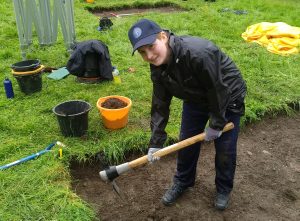
I also keep in mind the kind of hands-on historical activities teachers can introduce into the classroom when I write Key Stage 2 stories. In my Anglo-Saxon adventure story, Through Iron Eyes, eleven-year-old Mattie hates carding wool and spinning it into thread with a drop spindle, so she swaps her spindle for a chance to try out Prince Eorpwald’s sword! In my most recent story set at Skara Brae in Neolithic Orkney, eleven-year-old Cae has to do chores such as scraping skins with a flint knife, weaving reeds to make baskets, sewing furs and cutting peat. While the last of these might seem like a difficult activity to show children in real life, local archaeological groups (such as Archaeology Scotland) are adept at running free sessions for schools, which can include demonstrating to pupils how to use a mattock to cut turf. It’s harder than it looks!
While actual historical items are fragile, expensive and not suitable for children to play with in the classroom, it’s very easy to get hold of cheap reproductions and modern versions of historical objects online. For any teachers or parents looking to liven up a history lesson with hand-on activities that lead to interesting discussions about daily life in the past, I’d urge them to try using historical fiction in tandem with real-life objects to fire up children’s imaginations, and to help them step into the shoes of ordinary people in the past.