
This is a post based on the presentation I gave at the LitDrive National Conference on 29th March 2025.
Why is teaching writing actually quite hard?
I have the privilege of working with many schools. Some of this work is quite intimate and hands on, and some is more remote and advisory, but all of these schools in recent years have expressed the challenges they face with student writing. Many schools experience the same thing: students finish KS3 and arrive in Y10 without the basic skills they need to write accurately, effectively, stylishly… dare I say it, authentically?
Writing is the hardest thing we teach. It’s nails. It’s not just about knowing things, it’s about being able to DO things. Students need to have something to say in the first place, but they also need to know lots of words and structures in order to write anything coherent. It’s more complex than this, though. KNOWING a word or a grammatical structure is not the same as having experienced it in a range of contexts, and reaching a level of knowing which is plastic, malleable, even. Being able to say what a modal verb is isn’t the same as being able to make a judicious choice in your own writing. Students need to know what is possible, see it in action, and also have lots of experience of trying it out, in order to make that thing a part of their toolkit. I talk in more detail about types of knowledge in English in this post.
For me, the ultimate goal of teaching writing is that students can say precicely WHAT they want to say, exactly HOW they want to say it. In my experience, this happens on a sort of continuum where students start by mimicking their teacher and the texts they are reading and studying, and gradually over time they begin to develop their own authentic voice. This is something which takes time and, realistically, some of our young people might not reach that point while they are with us. I have had students who are writing in a really unique and personal style by the end of Y8 or Y9, and others who haven’t developed that level of confidence by the time they finish Y11. This is fine – I believe strongly that a really great writing curriculum provides the foundations so that our young people can reach that point when they are ready. Sometimes it will happen when they hit sixth form or college. Or perhaps they will come back to writing as adults, and the solid base of knowledge, practice and reflection we have built with them will come into its own and provide the support they need to fly.
What makes an effective writing curriculum?
I’m not claiming to be the font of all knowledge here, but the list below comes from my experience of teaching Secondary English for 16 years:
Teach discrete writing units
Lots of English curriculum is literature heavy. In theory, there is nothing wrong with leading with literature texts and using these to frame everything else. But in practise this often means that writing gets squeezed. For example, we might have an 8 week unit where we intend to study a novel and then do some character-based diary writing in the last 3 weeks. What often happens is that we spend a little longer reading the novel than we had intended, and then we linger over the analysis work, and in the end, the creative writing component is only a week long and we have no time to do anything but write one draft.
I don’t think big sweeping literature units with other things tucked in actually works. It COULD work in theory, but schools are busy places, and it is easy for us to lose focus in our curriculum intentions and delivery, especially when there’s a lovely book to distract us…
My solution is to have protected time carved out in the curriculum for writing, and to ensure that there is a very clear set of intentions for that writing unit. This is something I’ll address in more detail below…
LOTS of writing. Like, all the time.
I don’t think we write enough in English classrooms. What’s more, I think we THINK we spend more time writing than we actually do. My rule of thumb is that 25% of lesson time should be spent doing some kind of independent, purposeful writing. This means: in silence, focused on practisingdeveloping something specific. The core mantra in our Trust about writing is, ‘Writing is thinking. Practice is sacred.’ Writing is a highly generative process (see this brilliant article from Natalie Wexler). It’s something which, in and of itself, supports the processing and long term retention of information, but also sparks new connections, ideas and possibilities. My experience as an examiner for years has shown me that, for the most part, the best responses don’t get really good until closer to the end. I reckon that students start their essays by saying all the things they think they SHOULD say – the things their teachers have told them – and then later on in their writing, they start saying the interesting things in their own minds – the things which occur in the moment because they are thinking hard and engaging with difficult ideas in a focused, uninterrupted way. If students have time with their ideas, they start to have more interesting ideas. We can’t expect them to develop an authentic voice if all we do is teach lessons where we discuss something, model something, and then they only get 10 or 15 minutes to write a paragraph. Paragraphing skills are important, but that extended period where students get to sit with their ideas and write longer, more interesting answers, is truly precious.
I talk a lot about the ‘Big Write’ in my leadership courses for Heads of English, but there’s nothing complicated about it. We ensure that every Y10 student spends a full hour every week writing an essay. This is obviously done in a way which supports individual need and the starting point of students, but the goal is that, even those with the most profound barriers can write significantly more independently by the end of Y10 term 1 than they could at the start of it. In Y11, this increases so that students are doing extended writing for both Language and Literature tasks every week. This isn’t about drilling students and making them miserable. It’s about giving them the time and space they need to develop their voice, to develop a sense of themselves as a thinker and a writer, and also to develop confidence and resilience in what is a really difficult skill (remember – writing is nails…).
The ‘Big Write’ needn’t be anywhere near so prescriptive in KS3, but the principle remains – students need lots of opportunities to write at length – 25% is quite a good rule of thumb in my experience. This doesn’t always need to be a formal piece of writing in academic tone, or with specific form or tone constraints. This could be free writing: here is a statement about this character, tell me what YOU think… etc.
Map writing knowledge and skills in the same way as everything else

Now, depending on the way you build your curriculum, the idea of ‘mapping knowledge and skills’ may not mean a lot to you. You can see how I approach this in this post and in one specifically on grammar here. However, all I really mean about this is that a great curriculum needs to be more than a list of topic titles. We need to have clarity at every point about what we want students to know and be able to do at every point in the curriculum. For each unit, we present this in four categories: ASK, DO, OLD, NEW:
- ASK: What is the point of this unit – what are the big questions we might explore in literature, language, human experience, etc.
- DO: What will this unit actually look like – what will we read, watch, write, discuss, produce?
- OLD: What do students already know which is relevant to this topic? Teachers can ensure that they return to this content, revise, refine and deepen students’ understanding of existing concepts, and their confidence and sophistication with existing skills.
- NEW: What new knowledge or skills will we be introducing in this topic?
For each unit, we also have a section which explicitly details what writing content we will teach, model and practise – this includes lists of vocabulary, structures, grammar concepts and form conventions.
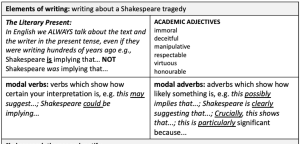 In this example, you can see that the writing content included: ‘The Literary Present’, which we decided was an important convention for academic writing which needed to be explicitly taught; some key adjectives which we would be able to teach and practise in that unit in a range of contexts (note – other adjectives would obviously also be used, but all students as a minimum foundation would learn and practise these ones); modal verbs and adverbs, which many would call ‘tentative’ language, are also explicitly taught and practised in this unit.
Please note – knowledge organisers are controversial, and deciding what knowledge to teach in English is a choice which is highly personal to individual schools and the cohorts they serve. I am sharing this example in good faith – I don’t put this out there as a paragon of perfect practice, or as the ‘only way’. This is just our way, for the time being.
This is an example of a traditional ‘reading’ unit, so a literature focus. But the principle is the same whatever the unit focus – there should be clarity about what we are teaching and what we want students to be able to to. In a specific writing unit, this section might also include sentence structures we want to focus on and practise using.
Now it’s important to clarify here – THIS, alone, is not the curriculum. A list of stuff on a page is not the curriculum. The teacher co-creates the curriculum with their class through their delivery, interaction, feedback, reflection, shared experience and personal response. This is an important point – I believe knowledge is key, and knowing where you’re going is key, but a knowledge organiser is not a curriculum.
Writing pedagogy: live modelling, drills, drafting, reflecting and editing
Once we have a clear sense of where we are and where we’re going, AND we’ve carved out time in the curriculum to make writing a priority, we have to think about how that looks in the classroom. There are lots of ways to do this well, but I think the ideas above are critical in all writing pedagogies. I’d heartily recommend the work of Ross Young and Felicity Ferguson, who have compiled some really excellent, evidence driven practical advice for the teaching of writing. Their book, ‘Writing for Pleasure: theory, research and practice’ is a must read.
In my experience, the most elusive part of writing pedagogy is getting students to write slowly, thoughtfully and to reflect at intervals on the choices they are making. This is something we have started to work on at Carlton Academy Trust, and I will expand on it in the second post of this writing series which will come out soon: ‘The Ways to Play’